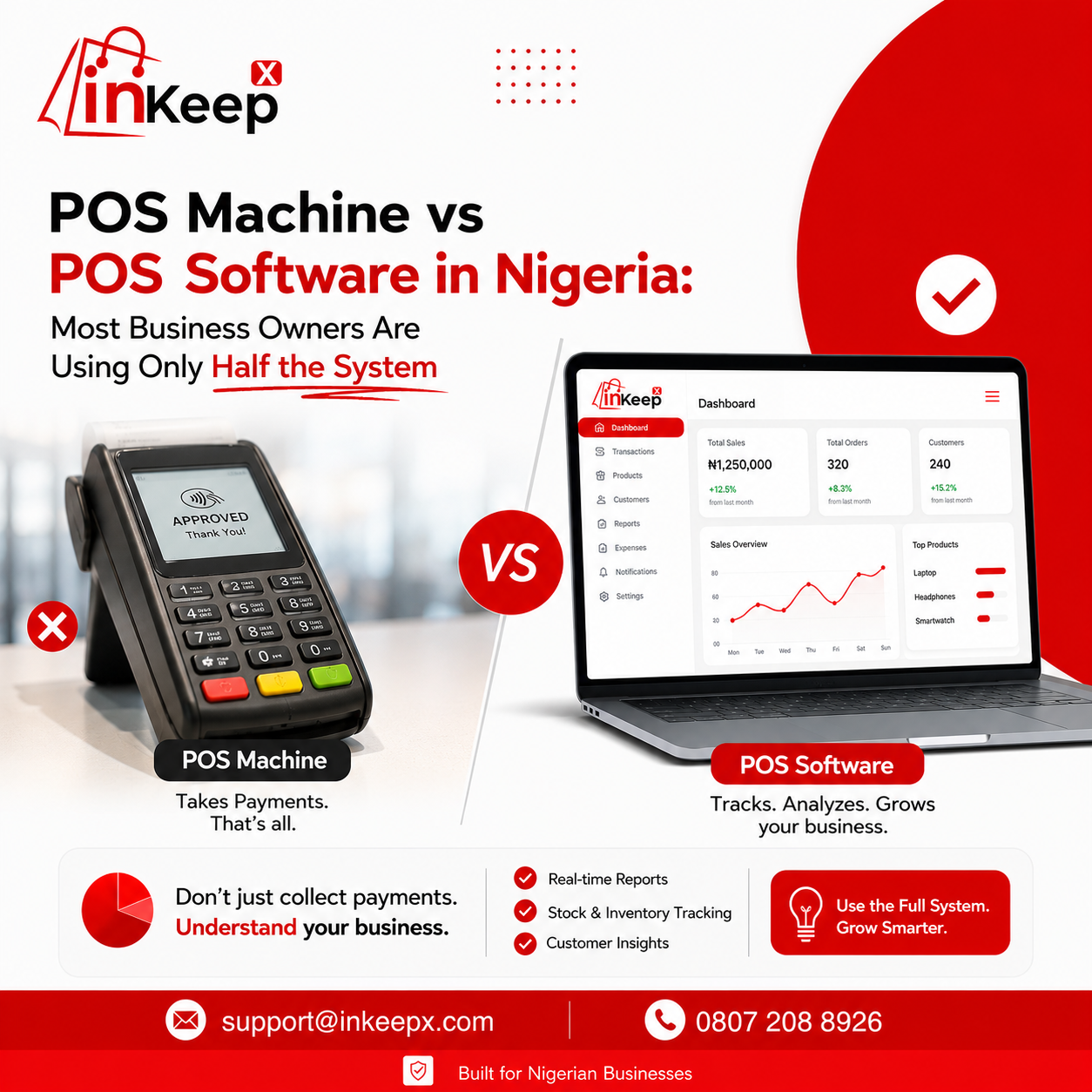
If you run a business in Nigeria and someone says "POS," you probably picture the small card machine from Moniepoint, OPay, or your bank. That's the device an agent uses to give cash, take card payments, and do transfers. But here's what trips up thousands of business owners: that machine is only one half of what "POS" really means — and it may not be the part your shop actually needs most.
There are two completely different things hiding behind those three letters: a POS machine (the payment terminal) and POS software (the system that runs your sales, stock, staff, and profit). Confusing the two is one of the most common — and most expensive — mistakes Nigerian retailers make.
This guide clears it up in plain terms: what each one is, which your business needs, and how they work together. By the end you'll know exactly what to buy and why.
Quick answer: A POS machine is the physical card terminal that collects payments (Moniepoint, OPay, bank POS). POS software is the system that runs your business — recording every sale, tracking inventory, managing staff, and showing your real profit. Many businesses need both: a machine to take payment, and software like InkeepX to actually manage the shop.
👉 Try InkeepX free — manage your sales, stock & staff in one place
What is a POS machine?
A POS machine (also called a POS terminal or card machine) is the small handheld device you see everywhere in Nigeria. Its job is simple: move money. It lets you accept card payments, do bank transfers, and — in the agent-banking model — give customers cash withdrawals.
In Nigeria, these machines come mostly from fintechs and banks: Moniepoint, OPay, PalmPay, Baxi, and traditional banks like GTBank or FirstMonie. With Nigeria's cashless drive, they've become a lifeline — Moniepoint alone has hundreds of thousands of active agents across the country.
What a POS machine does:
- Accepts debit/credit card payments
- Processes bank transfers
- Enables cash withdrawals (agent banking)
- Prints a payment slip
- Charges a small fee per transaction (commonly 0.5%, capped around ₦100)
What a POS machine does not do:
- It does not know what products you sold
- It does not track your stock or warn you when items run low
- It does not tell you your profit
- It does not manage your staff or catch theft
- It does not keep a record of your customers
A POS machine sees money moving — but it is completely blind to your business. It knows ₦5,000 came in. It has no idea whether that was one bag of rice or five recharge cards, whether you made a profit, or whether your stock is now running low.
What is POS software?
POS software is the system that actually runs your shop. Instead of just moving money, it records and manages everything that happens in your business. When you sell an item, the software logs the sale, reduces the stock count, updates your reports, and tracks which staff member made the sale.
What POS software does:
- Records every sale — what was sold, when, by whom, for how much
- Tracks inventory — live stock levels, low-stock alerts, expiry dates
- Shows your real profit — revenue minus cost, per product and overall
- Manages staff — separate logins, per-staff sales, audit trail to prevent theft
- Keeps customer records — loyalty, credit accounts, purchase history
- Generates reports — daily, weekly, monthly business insights
- Prints receipts and barcodes — professional checkout, scan-to-sell
In other words, POS software is the brain of your business, while the POS machine is just one of the hands that collects money. The software answers the questions that actually grow your business: What's selling? What's running low? Am I making money? Is my staff honest?
InkeepX is an example of modern, cloud-based POS software built for Nigerian businesses — it runs your sales, stock, staff, and reports from your phone, tablet, or computer, online or offline.
POS machine vs POS software: side-by-side
| POS Machine (terminal) | POS Software (system) | |
|---|---|---|
| Main job | Collect payments | Run your whole business |
| Examples | Moniepoint, OPay, bank POS | InkeepX |
| Tracks sales? | ❌ No | ✅ Yes |
| Tracks inventory/stock? | ❌ No | ✅ Yes |
| Shows profit? | ❌ No | ✅ Yes |
| Manages staff? | ❌ No | ✅ Yes |
| Customer records? | ❌ No | ✅ Yes |
| Works offline? | Needs network | ✅ Yes (with InkeepX) |
| Cost | Device + fee per transaction | Subscription (InkeepX from ₦5,000/mo, free plan available) |
The simplest way to remember it: the machine takes the money, the software runs the business.
Which one does your business need?
This is where the confusion costs people money. Here's the honest breakdown.
If you only collect payments (you're a POS agent doing withdrawals and transfers as your main business), a POS machine from Moniepoint, OPay, or a bank is your core tool. You don't necessarily need full retail software.
If you sell products — a supermarket, pharmacy, boutique, restaurant, electronics shop, mini-mart, or any store with inventory — then a POS machine alone is nowhere near enough. You can collect payment with it, but you still have no idea what you sold, what's left in stock, or whether you're actually making a profit. You need POS software.
Most product-selling businesses need both: a POS machine to accept card and transfer payments, and POS software to run the shop. They aren't competitors — they're partners. The machine handles the naira; the software handles the business.
Here's the mistake to avoid: many shop owners get a POS machine, see "POS" on it, and assume they're now "fully set up." Months later they still can't say which products make them money, why stock keeps disappearing, or where their profit went — because the machine was never built to tell them. That gap is exactly what POS software fills.
How POS software and a POS machine work together
In a well-run Nigerian shop, the two work side by side:
- A customer brings items to the counter.
- Your POS software (like InkeepX) rings up the sale — scanning barcodes, calculating the total, applying any discount or VAT.
- The customer pays. If they're paying by card or transfer, you use your POS machine to collect the money.
- The software records the sale, reduces your stock automatically, logs which staff member sold it, and updates your reports — all in real time.
The machine moved the money. The software captured the meaning. Together, you get paid and you stay in control of your business.
Why Nigerian businesses choose InkeepX as their POS software
If you've realised it's actually software you need to run your shop, here's why thousands of Nigerian businesses use InkeepX:
- Works offline — keep selling during network or power outages; everything syncs automatically when you're back online. (A huge advantage in Nigeria, where many systems stop the moment the network drops.)
- Real-time inventory — live stock tracking, low-stock alerts, and expiry-date monitoring.
- Barcode generation — print barcode and price labels, then scan to sell.
- Staff accountability — separate logins, per-staff sales tracking, and a full audit trail to reduce theft.
- Real profit visibility — see revenue, cost, and profit per product and overall.
- Built for Nigeria — Naira, local tax, cash and transfer culture, and multi-branch support.
- Affordable — a free plan to start, paid plans from just ₦5,000/month.
- Any device — free Android app, desktop app, and web access.
InkeepX doesn't replace your payment machine — it gives your business the brain it was missing.
Ready to actually run your business, not just collect payments?
A POS machine moves your money. InkeepX runs your shop — sales, stock, staff, and profit, online or offline.
- ✅ Start free — no credit card required
- ✅ Paid plans from just ₦5,000/month
- ✅ Works offline — never lose a sale to a network drop
- ✅ 24/7 support & free updates
👉 Create your free InkeepX account now or talk to our team.
Frequently Asked Questions (FAQ)
What is the difference between a POS machine and POS software? A POS machine is the physical card terminal (like Moniepoint or OPay) that collects payments — card, transfer, and cash withdrawals. POS software is the system that runs your business: recording sales, tracking inventory, managing staff, and showing profit. The machine moves money; the software runs the business. Many shops need both.
Is Moniepoint a POS machine or POS software? Moniepoint (and OPay, PalmPay, bank POS, etc.) is primarily a POS machine / payment terminal — its main job is collecting payments and enabling agent banking. It is not retail management software, so it won't track your products, stock, or profit. For that you need POS software like InkeepX.
Do I need POS software if I already have a POS machine? If you sell products, yes. A POS machine collects payment but can't tell you what you sold, what's in stock, or whether you made a profit. POS software fills that gap. Most product-selling businesses use a payment machine and POS software together.
Can POS software replace a POS machine? Not entirely — they do different jobs. POS software runs your business (sales, stock, staff, reports) but doesn't physically process card payments on its own; a payment terminal or payment gateway does that. The two work together: software to manage, machine to collect.
How much does POS software cost in Nigeria? It varies, but cloud POS software is typically a monthly subscription. InkeepX offers a free plan and paid plans starting from just ₦5,000/month — much cheaper than the losses most shops take from untracked stock and theft.
Does POS software work offline in Nigeria? Good POS software does. InkeepX is built offline-first, so you can keep selling and recording sales even with no internet, and it syncs automatically when the connection returns — essential given Nigeria's network and power realities.
What kind of businesses need POS software? Any business that sells products and wants to track sales, stock, and profit: supermarkets, pharmacies, restaurants, boutiques, electronics shops, mini-marts, bakeries, and more. If you carry inventory, you need POS software.
Which is the best POS software in Nigeria? The best POS software is one built for local conditions — offline support, Naira, multi-branch, and good local support. InkeepX is purpose-built for Nigerian businesses, with offline mode, inventory, barcode generation, staff controls, and plans from ₦5,000/month.
Stop guessing where your money goes. Start your free InkeepX account today and run your sales, stock, and staff in one place — online or offline, from ₦5,000/month.